You do not want to miss this year’s event, as we will be announcing some exciting news! Stop by to hear discussion from Qualys executives and customers on:
CEO Keynote: “Bringing the Unified Power of Qualys Cloud Platform to Address Today’s Security Challenges”
Rules allow you to move, flag, and respond to email messages automatically. You can also use rules to play sounds, move messages to folders, or display new item alerts.
The easiest and most common rule to create is one that allows you to move an item from a certain sender or with certain words in the subject line to another folder. You can create this rule directly from a message you’ve already received.
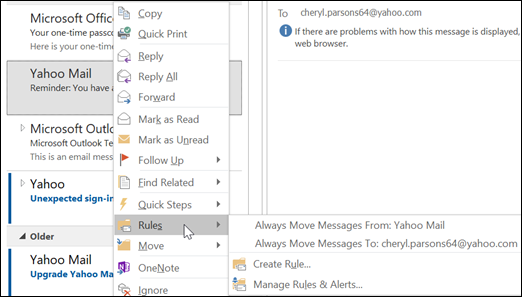
Right-click a message in your inbox or another email folder and select Rules.
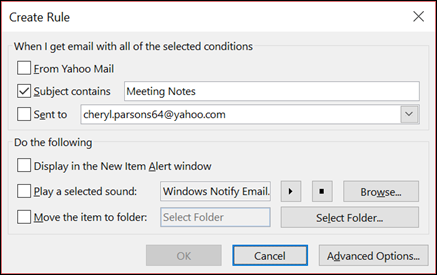
Select one of the options. Outlook automatically suggests creating a rule based on the sender and the recipients. To view more options, select Create Rule.
In the Create Rule dialog box, select one or more of the
first three checkboxes.
In the Do the following section, if you want the rule to move a message to a folder, check the Move item to folder box, then select the folder from the Select Folder dialog that pops up, and then click OK.
Click OK to save your rule. Note: If you want to run the rule on messages you’ve already received, check the box on the confirmation dialog that pops up and then click OK.
Create a rule using the Rules Wizard
There are three types of rules you can create with the Rules Wizard.
Stay organized: These rules help you filter, file, and follow-up with messages.
Stay up to date: These rules notify you when you receive a message that fits a specific set of criteria.
Custom rules: These are rules you create without a template.
Rules are almost infinitely customizable. There are a variety of options you can set for each type of rule you create. Use the following steps to learn how to create a rule using the Rules Wizard.Step 1Step 2Step 3Step 4Step 5
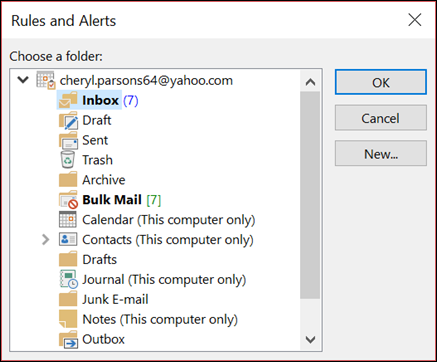
Select File > Manage Rules & Alerts to open the Rules and Alerts dialog box.
On the Email Rules tab, select New Rule.
Select one of the templates from Step 1. To start from a blank rule, select Apply rule on messages I receive or Apply rule on messages I send.
In the Step 2: Edit the rule description box, click on any underlined options to set them. For example, if you selected Flag messages from someone for follow-up in Step 1, click people or public group to select which senders’ messages you want to flag, then click follow up at this time to select a flag and a follow up date.
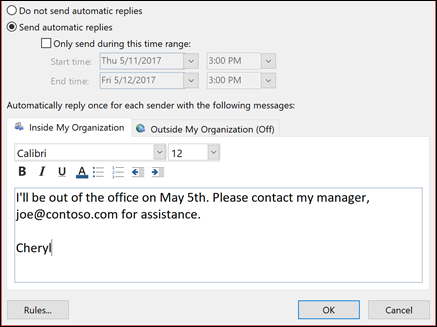
Select File > Automatic Replies. Note: For Outlook 2007 choose Tools > Out of Office Assistant.
In the Automatic Replies box, select Send automatic replies. Optionally, set a date range for your automatic replies. This will turn off automatic replies at the date and time you enter for the end time. Otherwise, you’ll need to turn off automatic replies manually. Note: If you don’t see Automatic Replies, use Rules and Alerts to set up your out-of-office message.
On the Inside My Organization tab, type the response that you want to send to teammates or colleagues while you are out of the office.
Note: Sending automatic replies to anyone outside my organization will send your automatic reply to every email, including newsletters, advertisements, and potentially, junk email. If you want to send automatic replies to those outside your organization, we recommend choosing My contacts only.
Select OK to save your settings.
Turn off automatic out-of-office replies
When Outlook is setup to send automatic replies, you’ll see a message under the ribbon with this information. Select Turn off to disable automatic out-of-office replies. If you want to modify the dates for your automatic reply or the message sent, use the steps above to modify your settings.
Note: For Outlook 2007, to turn off out-of-office replies, select Tools > Out of Office Assistant and uncheck the Send Out of Office auto-replies checkbox.
Update your Automatic Replies on the Outlook mobile app
You can update your Automatic Replies from Outlook for iOS or Outlook for Android. Click here to get the app and manage your Automatic Replies on the go.
Troubleshooting: I don’t see Automatic Replies
If you don’t see Automatic Replies after selecting File, you’re probably using a Gmail, Yahoo, or other POP or IMAP account that doesn’t support the Outlook Automatic Replies feature. This feature requires an Exchange server or an Office 365 account.
How do we keep track of this tool to stay up to date with our daily tasks and messages.
As a professional, we realise that our inbox is an important part of our daily routine.
We’ve all been there, right? After an exciting whirlwind vacation, you come back to work, open Outlook, and find two thousand unread messages waiting for you. It’s enough to make you want to go back on vacation. Or never take a vacation again.
But Outlook is a powerful program, and it can help you tame that inbox quickly—probably a lot faster than you could have imagined.
Preparing for vacation
Let’s follow along with Our self as we prepare to leave for a ten-day vacation.
We handle communication and coordination for five separate projects, we a member of twenty different mailing lists, and we also receives a small number of personal email messages each day.
While We are out of the office, a collogue will be the main point of contact for three of our projects, and another will handle the other two.
The last time You went on vacation, you set your Automatic Replies to let everyone know that you would be back in ten days, but didn’t do anything else. When You returned, your Inbox had grown from 50 messages to 500 messages or possibly many more.
This time, You could spend spend a few minutes the day before you leave with several of Outlook’s key features to help yourself come back from vacation stress-free.
We all know that setting up an Automatic Reply can head off a lot of questions and confusion for our coworkers. Since we have Microsoft 365, we can Select File > Automatic Replies, and types in the following text.
Hi,
Thanks for your message. I’m out of the office between “Start Date” and “End Date”. I will not be checking email while I’m gone.
For assistance with the Contoso, Fourth Coffee, and Tailspin Toys projects, please contact Chester Beane.
For help with the Northwind project, contact Cheryl Jenkins.
— “Your Name”
Now we can set our automatic replies to turn on the day we leave and turn off the day we get back. This is a great Step 1. However, we all know Outlook has other features we can use to help us keep our inbox under control.
Rules allow us to forward, delete or file mails in folders for any incoming email based on a from email address, text in the subject line or in the mail content.
After Vacation
What if you weren’t as organized as in the example above before you left on vacation?
Let’s follow the scenario without the above replies and rules as we attempt to deal with an overloaded inbox after a ten-day vacation. We did set up an automatic reply, but he didn’t give our coworkers any instructions while we were away.
When we return from our vacation, we have 1243 messages in our inbox. Luckily, we have Outlook as part of our Microsoft 365 subscription, so we can quickly and easily sort, filter, and deal with those messages using a few key Outlook features.
Step:
Sort
Filter
Search
Group
First, we sort our messages by priority. This places all of the high priority messages—those we’ll have to deal with quickly—at the top of the inbox.
To do this, we select the By Date dropdown at the top of the message list and chooses Importance. This sorts the inbox for us.
We can now spend fifteen minutes answering the five High importance messages, file them into folders, and then change the sort order by clicking the dropdown again and selecting Low on top to bring the Low importance messages to the top of our message list. These messages get only a quick scan, and then we delete all but one of them. “Lunch invitations”, a “fire drill notification”, and a “warning about a power outage” three days ago aren’t messages we need to reply to.
This course is intended for participants who want to improve their skill set even more, or are support staff.
Dozens of States poised to consider privacy legislation
Dozens of states are expected to consider privacy legislation in 2022, as California begins rulemaking for its newly revised consumer privacy law. “It’s no longer a Democrat thing or a Republican thing, and you’re increasingly seeing calls for greater privacy from both,” said Al Saikali, who heads the privacy and data security practice at Shook Hardy & Bacon.
Check out the updated hardware requirements for Windows 11 and find out how Windows Insiders can get started with a Windows 11 Insider Preview build.
Since launching Windows 10 six years ago, a lot of hardware innovation has happened in the PC space. For Windows to move forward and take better advantage of the latest innovations, we need to update the baseline system requirements for modern PCs. As a result, Windows 11 has updated hardware requirements which will be reflected in the Windows Insider Program. This blog post will outline what this means for Insiders new to flighting as well as Insiders who have already been flighting Insider Preview builds.
People can download the scanner and check to see if they have any malware and also clean their computers. Check if you have the 32Bit or 64Bit OS, click on the link and select save then click on the view in folder, double click the file and watch what happens
Microsoft Safety Scanner is a scan tool designed to find and remove malware from Windows computers. Simply download it and run a scan to find malware and try to reverse changes made by identified threats.
I was under the impression that Windows 10 was the last version on Windows with half year and annual updates. It seems that this planned pandemic has caused more ructions than we could have imagined. What we have been able to find out that the NSA have been spying on anyone and everyone over the past. They have been working with Microsoft, Linux, Apple and all hard disk and router manufactures to have spyware and backdoors in all operating systems worldwide. They have been the people hat have helped create the internet, all security software being used worldwide.
With the end of the current age and as we head into a new era, there are many changes forecast. One, a new Quantum internet (QI) is being put in place, one where hacking will be eliminated and second a new Quantum Financial system (QFS). This will require many changes to the O/S if we are to retain our current computing power.
So with Microsoft releasing a new OS at this time makes me think that this could be a release that could have everything ready for a switch over to the new QI.
Coalition to create framework for dealing with ransomware Major tech firms including Microsoft and McAfee, as well as research groups and other organizations, are creating a coalition to address cyberattacks against entities in government, education, health care and other critical sectors. The Ransomware Task Force will focus on threat reduction, tech solutions and the development of a standard framework for responding to ransomware for all industries to follow. Full Story: ZDNet (12/22), StateScoop (12/21)
 Note: For Outlook 2007 choose Tools > Out of Office Assistant.